The Library · By Candlelight · 25 stories
By Candlelight Historical and gothic horror stories
Horror from centuries that had no word for what was happening to them.
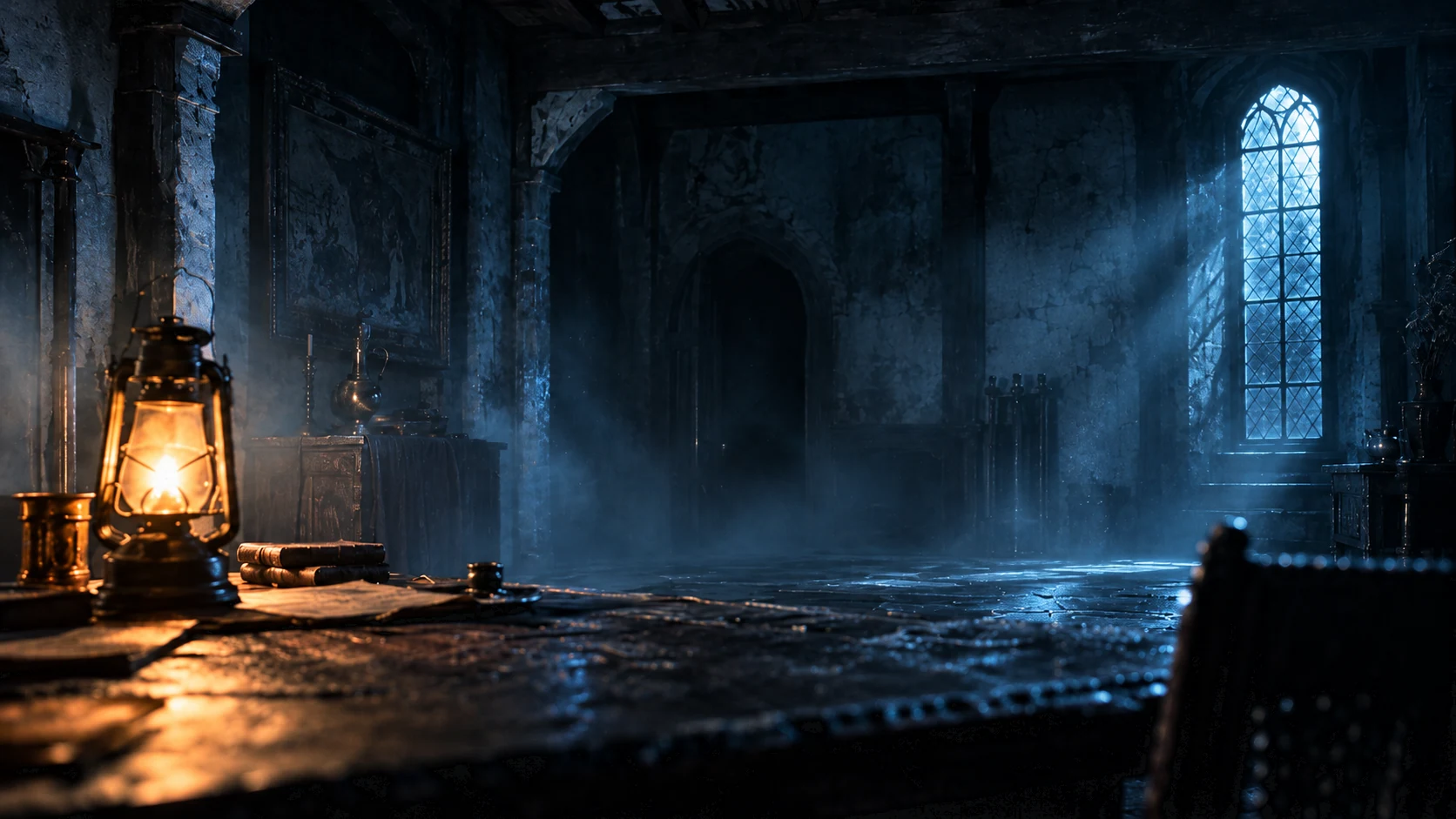
By Candlelight is the shelf of historical horror short stories. They are set between 1518 and 1906, in places you can find on a map: Haarlem under siege, a cliff in North Cornwall, the frozen Thames, a colliery in the Rhondda. The light is a candle or a lantern, and it never quite reaches the corners.
Many of them are gothic horror stories in the old sense. An asylum ward on nights. A post-mortem photograph in which the dead girl’s hand has moved. A funeral mute hired before anyone has died. Others lean towards folk horror, with a harvest custom or a mill that turns on windless nights.
A good number are based on real events. The Fiddler of Strasbourg is set in the dancing plague of 1518. The Ice Fair takes place at the last frost fair on the Thames, in February 1814. Bread for Haarlem is set in the last days of the siege, when one more person queues at the baker’s hatch each morning than the town says is alive. The events are real. The people in them are invented.
What the stories share is that nobody in them has a word for what is happening. They have registers, ledgers, logbooks and tallies instead, and the numbers stop agreeing.
For more from these centuries, see folk horror, ghost stories and plague and medical horror.
The Devil's Footprints
The first prints I saw went up a wall fourteen feet high and came down the other side as if the wall were not there.
The Drive
Mr McAllister's gibbet stood where the Long Covert came down to the Fakenham road, so that anyone driving up to Haverleigh Hall would see what a keeper did with his year.
The Porter
There was one pair of shoes too many in my car at two in the morning, on the first night out of Oakland, and I shined them, because that was the job.
The Wreath
On Kupala night in 1887 Agafya Kuzmina came down to the river for the first time since it had drowned her husband, and told her daughter where to float her wreath.
The Anatomy Lesson
The theatre over the Little Meat Hall was so cold that Jacob could see his own breath on the dead man.
The Bell
My master taught me to count breaths before he let me near the water.
The Bog
Water comes into a peat cut from underneath, and you hear it before you see it.
The Fiddler of Strasbourg
Write that I played thirty-one days for the council of this city and was paid for nineteen.
The Ice Fair
The ice talked the whole four days of the fair, and nobody minded it but me.
The Mute
Mr Tapp told me there was no body yet, and that I was to stand at the door until there was one.
The Rattle Watch
You asked me on Sunday why I say the hour before your clock strikes it, and I told you it was an old sailor's habit.
The Tuner
Pieter rang for wind at a quarter past ten, and the wind came before the bell had stopped swinging.
The Windmill
On my first day at the Grey Hen, the miller sat me on the weighing board, and his wife wrote down what I weighed.
The Wreckers
My grandmother taught me to make a ship out of a lame mare and a lantern.
Beset
Elias Brand took Aaron Kell a cup of water at four bells in the morning watch, and at breakfast the men talked about how well he had been buried.
Bread for Haarlem
The clerk chalks the number on my door at midnight, and tonight it is forty-one.
Exposure
The dead are the best sitters in London, Mr Pruett used to say, because they are the only ones who can hold still for a full minute.
Semper Augustus
Cornelis Wils had written the manner of death beside every page of the tulip book, because heirs were slower to pay than the living and he liked to know which contracts would need chasing.
The Farewell Rock
The top comes in at ten past eleven, and I know the time because Ifor Price has his watch open to see if it is food yet.
The Keeper's Log
The clockwork has to be wound every four hours, and Aaltje has learned to wake for it without being called.
The Last Sheaf
The intake field at Hollins lay so steep against the fell that Tobias reaped it half kneeling, and every time he stood to bind a sheaf he could see the whole dale below him, the river, the road, and nobody on it.
The Midwife's Testimony
The child had come with its cord three times round its neck, and by the second day of the trial everyone in Kaltenbach agreed that three was a witch's knot.
The Plague Clerk
Your Reverences have asked me to set down in my own hand why a leaf of the burial book of the Pieterskerk was scraped in the first week of September, and by whom, and I will do it as plainly as I can, because I have come to distrust anything I write when I am tired, and I am always tired now.
Ward C
The first thing Susan Kemp ever said to me was that I should mind the fourth stair when I went home.
The Duke Comes in Winter
The first person to see the Duke was old Willem Vos, and by the following morning he had given three different descriptions.
The bottom. Nothing has been written further down yet.
What readers ask
Are the historical horror stories true?
No. They are invented stories set in real places and real years, sometimes against real events such as a siege, a plague or a frost fair. The streets, dates and customs are drawn from history. The people in them, and what happens to them, are fiction. The fear is the only part I vouch for.
What is historical horror?
Historical horror is horror fiction set in a real past, where the setting shapes the fear. The people in it have their own beliefs, medicine and law, and none of the explanations we would reach for. A plague clerk has a register, not a theory. That is often enough.
What is gothic horror, and how is it different from historical horror?
Gothic horror is a tradition that began in the eighteenth century, usually dated to The Castle of Otranto in 1764: old houses, family secrets, decay, the dead not quite at rest. Historical horror is a setting, any real past. Many stories on this shelf are both, gothic in mood and historical in place.
Which stories are based on real events?
Several are set against real events: the siege of Haarlem in 1573 in Bread for Haarlem, the dancing plague of 1518 in The Fiddler of Strasbourg, the Leiden plague of 1635 in The Plague Clerk, the last Thames frost fair in 1814 in The Ice Fair, and the Rhineland witch trials of 1629 in The Midwife's Testimony.