Themes · 15 stories
Sea horror stories
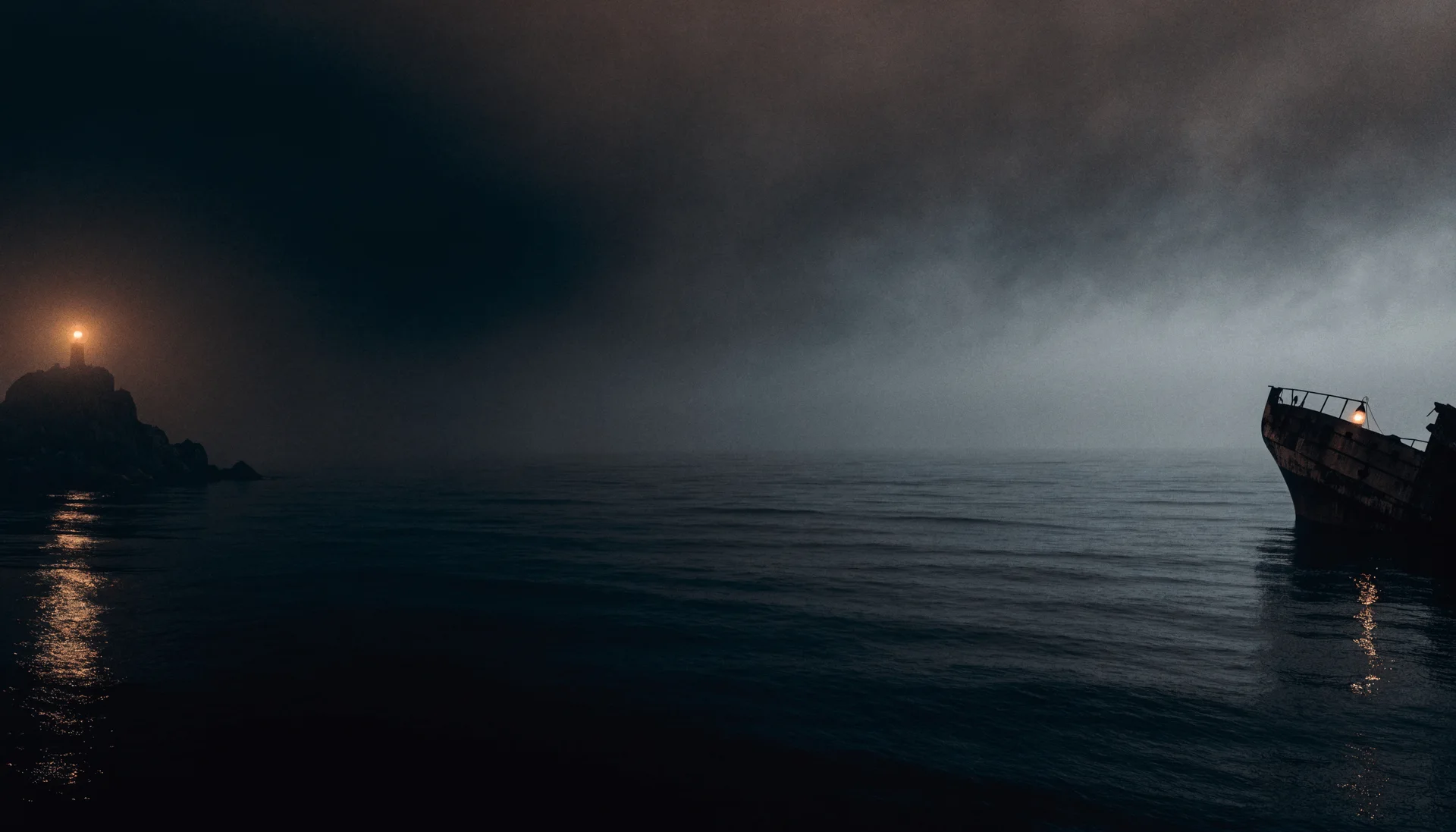
The water keeps everything it is given. Now and then it gives something back.
These are sea horror stories, and stories of drowning. Whalers locked in the Arctic ice. A lighthouse on a Frisian island. A diving bell in a winter sea. A wind turbine seventy kilometres out, and a ferry at night between Holland and Harwich. Water covers most of the world, and it keeps most of what it takes.
The sea in these stories is never only scenery. It is where the dead go unburied, where a wreck can be logged three days before it arrives, and where the voice in your last pocket of air belongs to a drowned man.
In The Bell, a diver off Texel in 1784 hears that voice offer to tell him where the silver lies. In The Keeper’s Log, a woman keeping her husband’s light records a wreck no one else can see. In Nacelle, a technician stranded at the top of a turbine counts the ladder rungs below her by sound, as something climbs them.
Not all of it is open sea. Some is a flooded quarry, a polder that was the sea floor within living memory, a frozen river. Water that has been drained or frozen still remembers being water.
For more of the drowned dead, see ghost stories. For wrecks and whalers in their own centuries, go to By Candlelight.
The stories
Newest first. Each one stands alone.
Ice Houses
Linnea runs forty fish houses eight miles out on the frozen Lake of the Woods, and at nine every night she checks on each of them by radio. One by one they stop answering, and the only tracks in the snow around them are her own.
Before you go in
- Murder, mostly as aftermath
- Drowning and bodies under the ice
- Missing persons
- A child in danger
House Rules
An out-of-work cook house-sits a polder farm in Flevoland for an old woman in hospital. She has left him three rules for the fog, and the last one says to answer nobody by name. What is calling across fields that were the sea floor sixty years ago, and how did it learn his?
Before you go in
- Death of an elderly woman in hospital
- A past drowning
- Guilt over a death the narrator may have caused
The Bell
Texel, 1784. Harmen goes down in a diving bell to raise the silver of an East Indiaman lost in the ice, and in the bell's small air a drowned man's voice offers to tell him where it lies.
Before you go in
- Suffocation and confinement under water
- Mass drowning in a shipwreck
- Guilt over a death that could have been prevented
The Listener of Hask
The city of Hask is built on the back of a leviathan that has slept for nine hundred years, and Ottilie is paid to lie with her ear to its hide and count its heart. The heart is getting faster. The council has ordered her to report it slower, and she is beginning to understand why.
Before you go in
- Forced sedation of the elderly, shown without violence
- People cast adrift at sea, referred to
- Anxiety and panic, described from the inside
Nacelle
A wind technician is stranded overnight at the top of a turbine seventy kilometres out in the North Sea. She counts the ladder rungs below her by sound, and something has started climbing them.
Before you go in
- Being trapped alone at height
- A death at sea, reported over the radio
The Ice Fair
London, February 1814, the last frost fair on the Thames. Ned prints souvenir cards on a press on the ice, until a hooded customer orders a card for a name, and that night the name is found frozen under the ice.
Before you go in
- Drowning, including the drowning of a boy
- Bodies found under ice
- Guilt over a death, and a lie told to a grieving mother
Wax
Every rower on the galley Patience has wax in their ears to pass the siren reefs. Galley slave Teodor's wax is softening in the heat, and through it he can make out what the sirens are actually singing.
Before you go in
- Slavery and forced labour
- Grief for a sibling
- Drowning
- Violence against prisoners
Passage
Joris opens the bridges of Zaandam at night from a control room thirty kilometres away. Every night at ten past three a barge calls him for passage, and nothing on any screen says it is there.
Before you go in
- Fear of causing a death at work
- Workplace suspension and loss of credibility
The Wreckers
North Cornwall, 1767, the winter they hanged an old wrecker at Launceston. Jory's family keeps a secret even from its own parish: a lantern, a lame mare and a signal that brings ships in. Tonight a ship out in the dark answers with the family's own signal.
Before you go in
- Deliberate shipwreck and drowned sailors
- Death of a sibling, kept secret by the family
- Hunger and poverty
- A burn injury
The Tow
Bas drives the night tow on the Afsluitdijk. For twenty-three nights he is called to the same small car halfway across, empty, engine warm, a child seat in the back, while a hooded man on the dyke watches him hook it up.
Before you go in
- A parent in crisis with a baby, at night, beside deep water
- Implied suicidal intent
- Danger on a motorway hard shoulder
Cabin 7117
On the night boat to Harwich, Esther hears her maiden name paged to the purser's desk, where a stranger in a hood is holding a bag she has not seen since she was seventeen. He says she left it behind. She remembers it differently.
Before you go in
- A child abandoned by a family member
- An abusive parent, implied rather than shown
- Grief after a parent's death
- Memory that has been rewritten to avoid guilt
Beset
A Hull whaler is locked in the Baffin Bay ice through the polar night. The cooper keeps the stores tally, and the crew begins to remember things he is certain did not happen.
Before you go in
- Starvation and scurvy aboard an icebound ship
- Implied cannibalism, never shown
- Killing of the sick, implied
- Coercion by a group
Headcount
A new teacher joins a winter swimming club at a flooded quarry and cannot stop counting heads. There is always one more in the water than there are tags on the board, and nobody else seems to mind.
Before you go in
- Drowning, including a death recalled from the past
- Hypothermia and dangerous cold-water exposure
The Keeper's Log
Terschelling, 1883. With her husband laid up, Aaltje Visser keeps the light and the log in his name, and records a wreck on the western sand that no one else can see. Three days later it arrives.
Before you go in
- Shipwreck and drowning, including a child
- A community that profits from deaths it could prevent
Pickup
At 02:41 a rideshare request asks Anouk to drive a quiet man to the house she grew up in, which was demolished years ago. She cannot afford to cancel, and he knows the way better than she does.
Before you go in
- A parent who disappeared, and implied death by drowning
- A parent locked out, witnessed by a child
- Parental drinking
- Dementia in an older parent
Other doors
- 12 storiesGhost storiesThe dead do not stay in houses. They go where they were last needed.
- 15 storiesNight shift horrorSomebody has to be awake at four in the morning. It is usually the wrong person.
Or choose a light to read by.
What readers ask
What is sea horror?
Sea horror is horror set at sea or on the water: ships, wrecks, lighthouses, divers, drowning. It draws on the oldest fears of sailors and coastal towns, of depth, isolation, weather and the dead who were never buried. The sea in these stories is never only scenery. It keeps what it takes, and sometimes gives it back.
Why is the sea so frightening in horror fiction?
The sea is frightening in horror because it is vast, deep and indifferent, and because so little of it can be seen. There is no shelter, help is far away, and the drowned have no graves. A ship is also a small closed world. When something goes wrong aboard, there is nowhere else to go.
Are there lighthouse horror stories here?
Yes. The Keeper's Log is set at a lighthouse on Terschelling in 1883, where a woman keeping the light in her husband's name records a wreck nobody else can see. Three days later it arrives. Nacelle, set at the top of a wind turbine in the North Sea, is a modern cousin.
Are the sea stories set in real places?
Yes. They are set in real waters and real years: the Baffin Bay ice in 1836, off Texel in 1784, the North Cornwall coast in 1767, the North Sea off IJmuiden today. The places are real and the history is drawn from them. The stories, and the people in them, are invented.